Sagging ceiling repairs, starting with why it dropped
We start these jobs in the roof space with a torch, not underneath with a screw gun. A sagging ceiling is a symptom rather than a fault in itself, and a dozen separate things can make one drop. Put new screws through a ceiling that let go for a reason nobody looked for, and you buy time rather than a repair. We repair sagging and cracked ceilings in Wollongong, Shellharbour, Kiama and down through the Shoalhaven. What you get from us first is a cause, in writing, with photographs. It says plainly which repairs will hold, and which will not until something else is fixed.
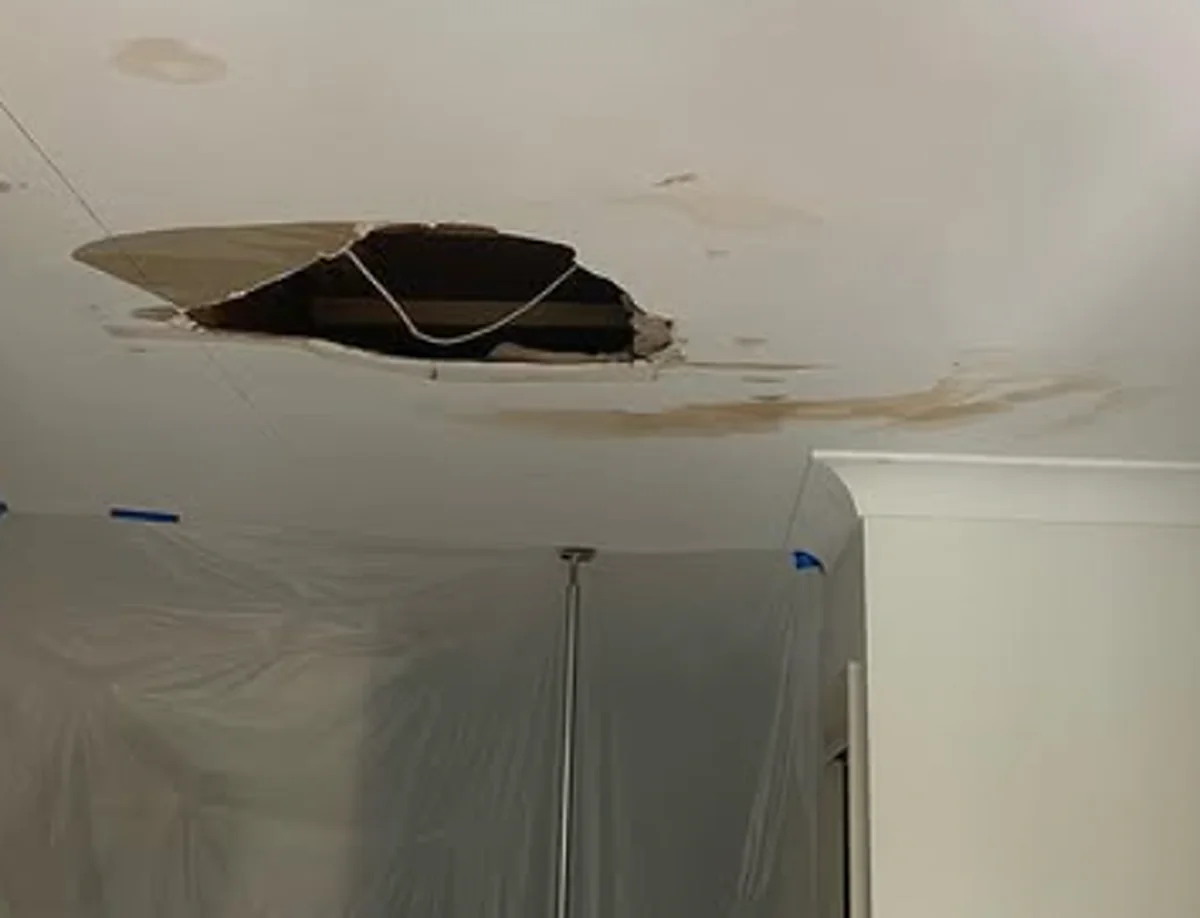
Working out why the ceiling dropped
This is the part that makes the difference and it is the part nobody else sells. We make the room safe first, prop anything that needs propping, and keep people out from under it. Then we go into the roof space and work a checklist. How the sheet is held, and whether it has separated from the framing. What is sitting on it, and whether the framing has been cut for a duct or a unit. Where the exhaust fans discharge, and whether water is still getting in. And whether the loads up there are ones the ceiling was ever meant to carry. Where the cause belongs to another trade we say so plainly. Repairing the ceiling before that is fixed will not hold, and we say that too. Either way, you get the cause in writing with photographs.
- Made safe and propped before anything else
- Inspected from the roof space, not the floor
- Moisture meter on every stain
- Photographed throughout
- The cause written down, not only a price
- Told plainly when another trade goes first
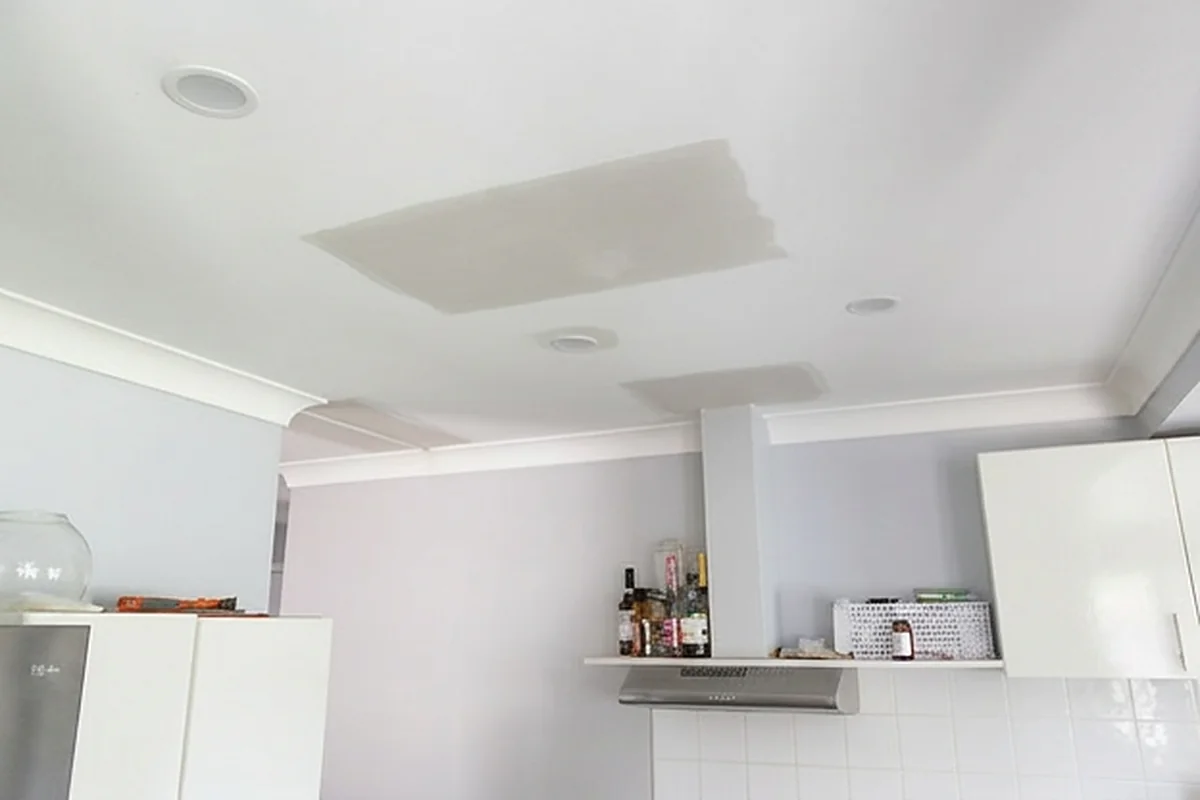
Re fixing and reinforcing a ceiling that is still sound
Where the board is dry and undamaged and the framing is sound, the ceiling gets fixed back to the framing properly. The failed fixings are made good at the same time. The regulator's own words are worth repeating here, because they are more reassuring than anything we would say about ourselves. Reinforcement and repairs will almost always be a more straightforward option than a full ceiling replacement. That holds only where the cause has been dealt with. A ceiling re fixed under a live leak, or under a load nobody removed, comes back. We will tell you when that is the situation rather than take the job twice.
- Board and framing assessed before anything is fixed
- Fixed back to the framing, not to the old holes
- Popped fixings cut out and made good
- Cause dealt with first or the job does not start
- Jointed, sanded and left ready for the painter
- Cornice renewed where it has dropped with the ceiling
Levelling a ceiling on furring channel
Sometimes the existing plane is out, or the ceiling is better left in place than pulled down. Furring channel underneath gives a true flat surface and a reliable steel line to screw into, independent of old timber. Direct fix brackets are set to a laser, and once the plane is right each bracket is permanently fixed. That takes two nails or screws per bracket, so nothing can shift afterwards. A minimum 10mm clearance stays between the joist and the furring. That is what lets the new plane be level over framing that never was. It costs ceiling height, a small amount, and it adds weight, so we check the structure can carry it before we start.
- A true plane over framing that is not
- Brackets levelled to a laser first
- Two fasteners per bracket once levelled
- 10mm minimum clearance to the joist
- Channel section and spacing set by the site
- Old ceiling stays up, new plane goes under it
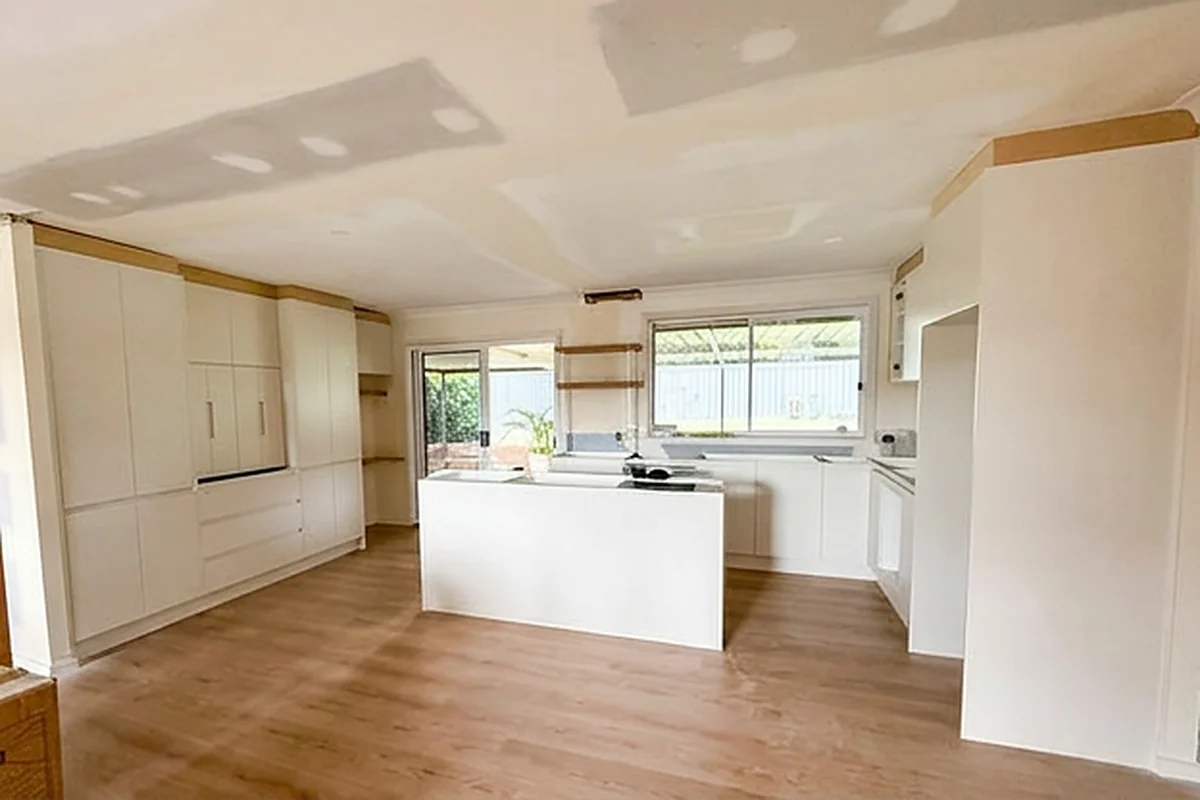
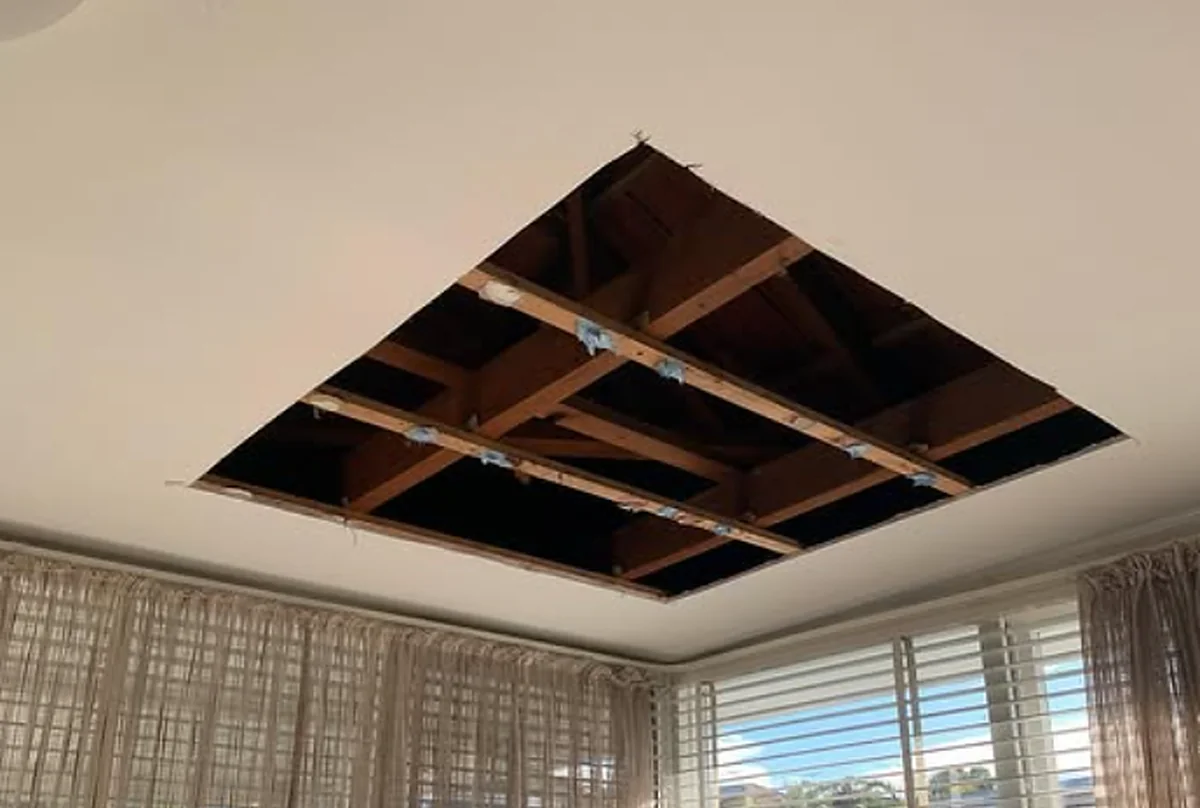
Replacing a ceiling, in part or completely
Some ceilings do not get re fixed, and the wet ones are the clearest example. A sheet that has been substantially wet is replaced rather than dried and screwed back up. Once the paper is wet or has broken down, the board loses strength and the fixings lose their grip on it. New screws into a sheet like that are holding onto something that is no longer there. The same applies where the framing itself needs work rather than the board. Replacement can be one bay or one room rather than a whole house. Where new board meets old, we treat that junction as the thing most likely to crack later, and detail it accordingly. Cornice usually comes off with the ceiling and gets renewed rather than refitted.
- Substantially wet board replaced, not re fixed
- Partial replacement where the damage is local
- Junctions between new and old detailed for movement
- Cornice renewed rather than refitted
- Old material taken away
- Sanded and handed over for the painter
What people are looking at when they call us
The ceiling has visibly dropped and you want to know if it is safe
This is the call we get most and it deserves a straight answer. A ceiling that is visibly sagging is a load that has already partly failed. We prop it before anybody works under it.
There is a line of small circles or blisters across the ceiling
That line follows a joist, and it means the sheet is separating from the framing above it. It is on the regulator's published list of warning signs, and it is the one people mistake for a paint fault.
It started after a storm and there is a stain
Water gets in at the roof and the ceiling shows it weeks later. The honest answer here usually involves a roofer as well as us, and we say which one has to go first.
It started after insulation went into the roof space
A ceiling built decades ago was designed around a load. Insulation added later sits directly on the sheet. This is the most satisfying cause to find, because it is the cheapest one to prove.
It started after an air conditioner, exhaust fan or downlights went in
Framing cut for a duct, or a unit resting on the sheet. It can also be a fan blowing warm wet air into the roof cavity instead of outdoors. All three show up on the ceiling months later.
The cornice has come away from the ceiling line
A dropping cornice is a warning sign in its own right rather than a cornice problem. We look at what the ceiling is doing before we look at the cornice.
How we work out what is wrong
The four warning signs a building regulator publishes
Western Australia's Building Commission lists them for homeowners after investigating real ceiling collapses. Cracking sounds from the ceiling. Sagging or dropping of the sheeting or the cornice. Visible cracking, and small circles or blisters in a line where the sheet is coming away from the joist above. Its advice if you see any of them is not to wait.
The diagnosis happens in the roof space
Almost nothing that causes a ceiling to sag is visible from the floor. We go up with a torch, a moisture meter, a laser and a camera. We look at how the sheet is held and what is sitting on it. We check whether water is still getting in, where the exhaust fans discharge, and whether anybody has cut the framing. You get the photographs whether or not you use us.
Nothing should be hanging off the ceiling itself
Services, light fittings, ducting, pipework and anything stored up there belong on the framing or the structure, never on the plasterboard. A ceiling is not a floor and it is not a shelf. Loads that were added years after the house was built are one of the causes a homeowner can see. It is one they can understand and stop in an afternoon.
Where a dropped ceiling stops being a clipped one
Up to 200mm below the structure, a ceiling can run on furring channel held by direct fix brackets. Past that it has to be properly hung. On a repair that line matters. It tells us what can be done underneath a ceiling that is already there. It also tells us how much room there is to bring the finished plane back to level.
What the framing may span is set by the site
Furring channel spans are published by wind category, and they change with the section as well. The deeper P129 carries further than the shallower P308, and a continuous run carries further than a single span. Every one of those numbers tightens as the wind category rises. An exposed site is not the same job as a sheltered one, on the same house plan.
Get a free quote
Send photographs, because a sagging ceiling is one of the few jobs we will not price sight unseen. A picture tells us the room, the extent and often the pattern of the movement, which is the first clue to the cause. One wide frame and one close frame of the worst area is enough to start. If it is moving, or if you can hear it, say so in the message and we will treat it that way.
Brands we supply, install and repair
We supply the board, the cornice and the compound on every job, and these are the brands we sheet with.
Service available across every Wollongong region
The Northern Illawarra
Helensburgh, Stanwell Park, Coalcliff, Scarborough, Austinmer, Thirroul, Bulli, Woonona, Russell Vale, Corrimal, Towradgi, Balgownie and Fairy Meadow
Wollongong and Dapto
Wollongong, North Wollongong, West Wollongong, Coniston, Mangerton, Figtree, Cordeaux Heights, Mount Keira, Unanderra, Berkeley, Port Kembla, Warrawong, Kanahooka, Horsley, Koonawarra and Dapto
Shellharbour and Kiama
Albion Park, Albion Park Rail, Oak Flats, Lake Illawarra, Mount Warrigal, Barrack Heights, Warilla, Flinders, Shell Cove, Shellharbour, Blackbutt, Minnamurra, Kiama Downs and Kiama
The Shoalhaven
Nowra, North Nowra, South Nowra, Bomaderry, Worrigee, Sanctuary Point, St Georges Basin, Vincentia and Huskisson
The Southern Highlands
Mittagong, Bowral, Burradoo, Moss Vale, Berrima and Renwick
Frequently asked questions
How do I know if my ceiling is about to come down?
Nobody can answer that from a photograph with certainty, and anybody who does is guessing. What is known is which signs mean a ceiling is under stress. Cracking sounds, sagging sheeting or cornice, visible cracking, and small circles or blisters in a line where the sheet is separating from the joist. A ceiling showing any of those is a load that has already partly failed. Keep people out of the room, do not put anything else in the roof space, and get it looked at rather than watched.
Can you screw a sagging ceiling back up rather than replace it?
Yes, in most cases, and only once the reason it let go is known. Where the board is dry and sound and the framing is sound, re fixing a ceiling to the framing is a real repair. It is the usual repair on a ceiling like that. Where the sheet has been substantially wet, new screws hold for a while and then do the same thing again. The same goes for a load still sitting on it, or water still coming in. Re fixing a ceiling without finding the cause is the most common way this repair gets done twice.
Does the whole ceiling have to be replaced?
No, usually not. The building regulator that investigated real ceiling collapses is plain about this, and it matches our experience. Reinforcement and repairs, it says, will almost always be a more straightforward option than a full ceiling replacement. Replacement is for board that has been substantially wet, board that has broken down, and ceilings where the framing itself needs work. Everything else is a re fix, a levelling system underneath, or one bay taken out and replaced. The extent gets decided after the roof space inspection, not before it.
Why does a wet ceiling need replacing if it has dried out?
Because the strength is in the paper, and the fixings hold onto the paper. Once a sheet has been substantially wet, the manufacturer's position is that it be replaced. Wet or deteriorated paper reduces both the strength of the board and the holding capacity of the fasteners in it. A ceiling that looks dry and flat can have lost the grip that was keeping it up. That is a structural change rather than a stain, and it is why a dried out ceiling is not automatically a saved one.
My cornice is pulling away from the ceiling. Is that a cornice problem?
Not usually, because the cornice is showing a problem rather than having one. A sagging or dropping cornice is on the building regulator's published list of warning signs that a ceiling is under stress. So are cracking sounds, visible cracking, and a line of small circles or blisters. Cornice sits at the junction of two planes, so it shows movement earlier and more obviously than the middle of a ceiling does. So the ceiling gets assessed first, and the cornice is looked at after that. Re running cornice on a ceiling that is still moving is decoration over a fault.
Can an uneven ceiling be levelled without pulling it down?
Yes, in most cases. Furring channel fixed underneath on direct fix brackets creates a flat plane. It gives a consistent steel line to screw new board into, independent of framing that has moved. The brackets are levelled to a laser and then permanently fixed with two nails or screws each. A minimum 10mm clearance is kept between the joist and the channel. It costs a little ceiling height and adds weight, so the structure gets checked first. Below 200mm of drop this is a clipped system rather than a hung one.
The cracks are in a house only a few years old. Is that a defect?
It may be, and there are published thresholds for exactly this. In NSW, cracking in ceilings and in recessed and butt joints is defective if it is there at handover. It is also defective if it exceeds 1mm within 24 months. Nail popping is defective at handover or within 24 months as well. Those are the published thresholds in the state's guide to standards and tolerances, and they apply to the builder rather than to us. We can tell you what we find and put it in writing with photographs, and what you do with that is your decision.
What do you need from me before you can quote it?
From photographs, which is where every one of these jobs starts. A sagging ceiling is quoted on what caused it, how far it has gone, and how much of the ceiling is involved. A picture tells us more about all three than a description does. Send a wide shot of the room and a close shot of the worst part. Where the photographs are not enough, we come and look, and that costs nothing wherever you are in the service area. Repairs are usually started within two to three business days.
Ready to get started?
Get a free quote, or call and tell us what the job is.